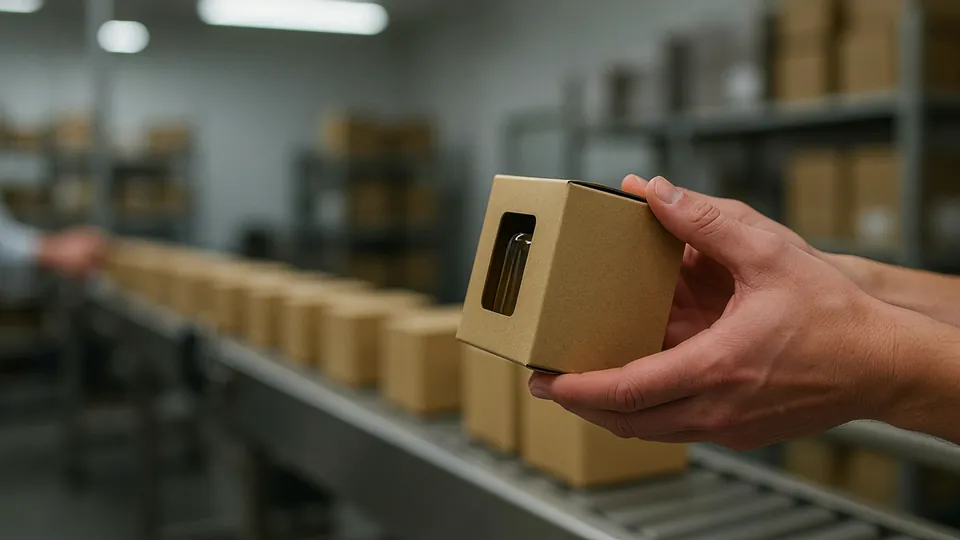
Thousands of packages in your warehouse. But do you have the right ones in stock?


Cardboard boxes in twenty sizes, plastic film in five thicknesses, trays, bags, tape, and packing material. Whether you sell packaging or manufacture it yourself, your warehouse can quickly fill up with thousands of items. You want to be able to deliver to your customers quickly, but you don’t want your warehouse to be cluttered with packaging that hardly ever sells. With SAP Business One, you can tailor your inventory to what your customers actually buy.
This tension is just as much of an issue for wholesalers as it is for manufacturers in the process industry. Customers often place orders at the last minute, because without packaging, their own production or shipping comes to a standstill. At the same time, you source from suppliers in Europe and the Far East, which involve long lead times and minimum order quantities.
If you manufacture packaging yourself, you also need to account for raw materials, semi-finished products, and packaging materials. You need to have these on hand before you can start production, but you also don’t want to tie up too much capital in them unnecessarily.
With SAP Business One, you’ll know which packages are actually selling
Not every item deserves the same attention. A handful of standard boxes and rolls of tape often account for the bulk of your revenue. In addition, you have a long list of sizes and varieties that are shipped out just a few times a year. For a manufacturer, the same applies to raw materials: some types of cardboard or plastic film are used up every week, while others are used only a few times a year.
If you want to optimize your inventory, you need to start with insight. In SAP Business One, you can see for each item how often it’s sold, in what quantities, and how stable the demand is. This allows you to categorize your product range: the fast-movers you can never run out of, the items with erratic demand, and the packages that are best delivered on a made-to-order basis.
A full warehouse doesn’t necessarily mean you have the right inventory.
This also helps you identify your slow-moving inventory: boxes that haven’t sold in months, a size a customer no longer buys, or outdated printing. Just ask your system these questions, and you’ll get an answer right away. That way, you can take action before it costs you any more space or money.
Ordering based on sales, lead time, and minimum order quantity
For each item, you set a minimum and maximum stock level based on how well the item is selling. If stock falls below the minimum, your buyer receives a reorder recommendation. In this recommendation, SAP Business One takes into account the supplier’s lead time, what’s already in transit, and the orders that are ready to ship. If you manufacture your own products, the planning system also considers upcoming production orders: which cardboard, which film, and which ink you’ll need—and when.
Does a supplier have a minimum order quantity, or do you buy by the container? You’ll see that information in the same proposal. You can combine items from a single supplier and smartly supplement your order without overstocking a single item just to be safe. For seasonal peaks, such as the e-commerce rush leading up to the holidays, you can plan ahead based on last year’s sales. Learn more about efficient purchasing.

Stock for your regular customers, without having to guess
Many packaging companies maintain inventory for regular customers, whether they’re retailers or manufacturers. A customer agrees to an annual purchase and places orders in installments. Or you keep a printed box in stock—whether purchased or produced in advance—that’s intended solely for that one customer.
In SAP Business One, you record those agreements in a contract with the customer. You can see how much has already been called off, what’s still outstanding, and until when. Customer-specific packaging remains reserved for that customer and won’t accidentally end up in an order for someone else. If you also set up a purchase contract with your supplier, what you purchase will align with what your customer is going to buy.
If you know what a customer is going to order next, you don’t have to guess when placing a purchase order.
If you have consignment inventory at a customer’s location, you manage it as a separate location. You know exactly what’s at the customer’s site and invoice only what has been used.
Eggink Verpakkingen: Fast delivery from two warehouses
Eggink Verpakkingen has been supplying packaging since 1956, ranging from food packaging to industrial and retail packaging. The products come from all over Europe and the Far East and are shipped to customers via warehouses in Enschede and Winterswijk.
SAP Business One is the company’s digital foundation. Customers place orders through the online store, and the back-office team generates reports at the customer level.
“You want to be able to deliver quickly, but also keep inventory at an acceptable level.”
Aafke te Focht, operations manager at Eggink Verpakkingen
Wondering how to manage your packaging inventory in SAP Business One?
A Logres consultant will show you based on your own product range.
In the warehouse, the inventory is actually accurate
An order proposal is only as good as the inventory figures behind it. The WMS is fully integrated with SAP Business One: you scan incoming shipments, every transfer, and outgoing shipments. Every movement is processed immediately, so your inside sales team sees the same inventory as the warehouse. If you work with batches of raw materials, you can also see which batch is located where and which one needs to be used first.
You’ll notice this on the customer’s end, too. When they place an order in your online store, they’ll see exactly what’s actually in stock.
A partner who knows the packaging industry
For over thirty years, Logres has worked exclusively with wholesalers and manufacturers in the process industry. Packaging wholesalers and packaging manufacturers are key sectors in this field. Our consultants are familiar with framework agreements involving call-off orders, packaging, private label products, and sourcing from suppliers on the other side of the world, as well as bill of materials, production planning, and batch management.
Before implementation begins, you’ll work together to assess how your inventory and purchasing currently operate. SAP Business One will be configured accordingly, based on the best practices of tens of thousands of companies. That way, you’ll know exactly where you stand from the start. Learn more about Logres’ approach.
If you’re a wholesaler that primarily deals in standard items, then Klipboard Wholesale is also a strong choice. Do you manufacture your own products, or do you want to tailor your services to each customer with call-off contracts, customer inventory, and customization? Then SAP Business One is what you need.
Read more
 Knowledge base