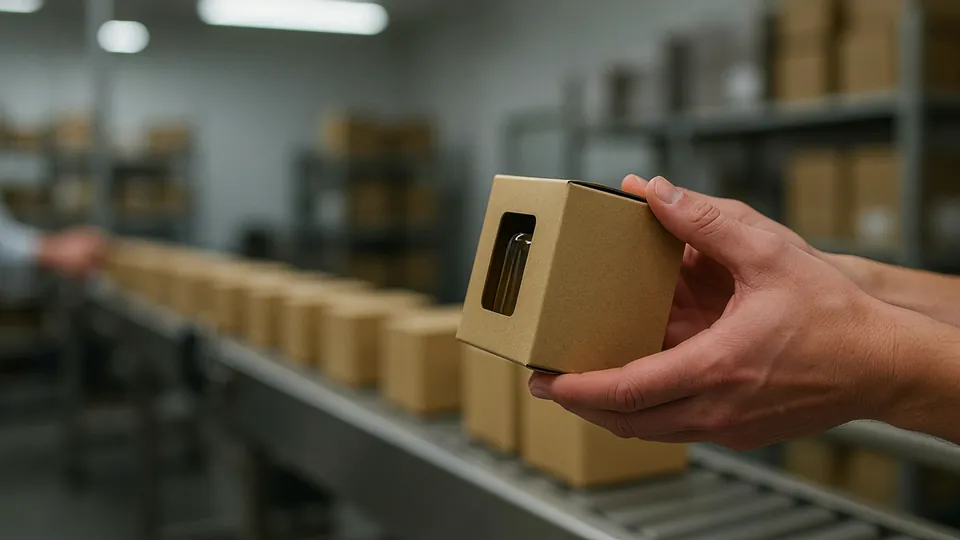
More and more custom packaging, smaller and smaller print runs. How do you keep it profitable?


One customer wants 2,000 boxes in a non-standard size, with their own print design. A week later, another customer asks for almost the same box, but made of recycled cardboard and with a different closure. In the packaging industry, this is everyday reality: more and more custom packaging, in ever-smaller production runs.
Customization builds customer loyalty. You’ll only turn a profit if you calculate quickly and accurately, factor setup costs into the price, and know afterward which orders actually generated a profit. With SAP Business One, you can manage all of this in a single system, from quote to post-sales analysis.
With SAP Business One, every custom order becomes a repeatable process
With custom work, the risk rarely lies in the production itself. It lies in everything surrounding it: a quote put together based on a hunch, specifications sent in an email, and a proof that no one even looks at anymore.
In SAP Business One, you define custom packaging as an item with characteristics such as size, material, printing, closure, handles, or window. These characteristics are carried over from the quote to the sales order, the production order, and the purchase of materials. No one has to retype anything, and everyone works with the same specifications.
Customization is only profitable if you don’t have to reinvent the wheel every time.
If a customer asks for a box that’s almost identical to last year’s, you don’t start from scratch. You take the existing specification, adjust the material or the printing, and save it as a new version. The old one remains accessible, including its original cost.
Base your calculations on your bill of materials, not on a hunch
With a small print run, every minute of setup time counts. Setting up a printing press or changing a die takes just as much time for 500 units as it does for 50,000. If you don’t factor that into the price, you’ll be selling small runs below cost without even realizing it.
In SAP Business One, you calculate the quote using the bill of materials and the packaging production steps: materials, printing, setup time, machine time, and the scrap you can expect with a new order. This way, you can immediately see what a packaging item costs for a run of 1,000 units and how the cost changes for 5,000. You can then back up a volume discount with actual figures.
If a proof is required, you can see for each order which proofs are still pending and when they were sent to the customer. The order won’t proceed to production without the customer’s approval. This way, you avoid producing a batch that the customer doesn’t want, which would then remain in your warehouse as customer-specific inventory.

Know which customers and which print runs are truly profitable
Afterward, you compare your initial calculations with the actual cost of the order: materials used, actual setup time, and scrap. That post-production calculation comes directly from the production order, without anyone having to spend hours on a spreadsheet.
This way, you can see which customers and which types of custom work are profitable and where your margin is being eroded. Perhaps a run of fewer than 1,000 units is only profitable with a fixed setup fee. Or maybe the profit lies in repeat orders, where the die-cut template and printing plates are already ready to go. You ask your system those questions, and you get the answer right away.
You don’t make money on custom work—you make money on custom work that you can account for afterward.
The terms regarding custom work are also clearly defined. If you create packaging exclusively for one customer, it cannot accidentally end up in a quote for another customer. And if you work with framework agreements and call-off orders, you specify how much a customer is allowed to change and by when.
Eggink Verpakkingen: Reporting at the customer level
Eggink Verpakkingen is a family-owned business that has been supplying packaging since 1956, from factories to smaller customers. Its product range extends from food packaging to industrial and retail packaging, with regular custom orders such as printed packaging.
The previous industry-specific software package was no longer being developed. Since switching to SAP Business One, Eggink has a much better understanding of what each customer contributes to the business.
“Ideally, we can generate reports at the customer level. That way, we can quickly see if a customer generated more revenue with us last year than this year. We can then plan accordingly.”
Kerstin Veenhuis, Head of Internal Sales at Eggink Verpakkingen
Curious about how to calculate and review the costs of custom packaging in SAP Business One?
A Logres consultant will show you how, using your own packaging as an example.
A partner who knows the packaging industry
For over thirty years, Logres has worked exclusively with wholesalers and manufacturers in the process industry. The packaging industry is a core sector for them. The consultants are familiar with proofs, private label, packaging, and framework agreements with call-off orders, and don’t need to be told why a small production run requires a different cost calculation.
Before implementation begins, you’ll work together to map out how your custom packaging process works, from request to post-calculation. SAP Business One is configured accordingly, based on the best practices of tens of thousands of companies. This way, you know exactly what to expect in advance and go live with a system that fits the way you manufacture and sell packaging. Learn more about Logres’ approach.
Read more
 Knowledge base